

The military escalation of Donald Trump in Gulf waters will bring Iran to the negotiating table to discuss, among other issues, the evolution of its nuclear program, a cause of deep concern in Washington. The president Masud Pezeshkian ordered this Monday to indirectly resume dialogue with the United States, according to the agency Farsand the supreme leader Ali Jamenei He had no objections to the Government’s strategy.
According to the digital Axios and the agency Reutersthe parties hope to maintain this Friday in Istanbul their first contact since the Twelve Day War in June last year. Operation Midnight Hammer then failed to achieve its objective of dismantling Iranian nuclear facilities. For this reason, Trump is now exploring the possibility of reaching a negotiated solution.
Türkiye and Qatar will try to guide the talks, and both Egypt and Saudi Arabia will have a reserved seat in Istanbul, as confirmed by Trump’s special envoy, Steve Witkoff. The foreign ministers of Oman, Pakistan and the United Arab Emirates, whose diplomatic efforts prevented the United States from launching an attack on Iran last week, are also expected to attend this Friday.
“The identity of the mediators matters,” he emphasizes Danny Citrinowiczanalyst at the Atlantic Council. “Qatar and Turkey, each with their own strategic interests, have considerable influence over both Tehran and the White House, giving them a potentially relevant role in developing outcomes.”
The development of the Iranian nuclear program will be on the table. Moscow maintains its offer to enrich its uranium in Russian territory, as the Kremlin spokesperson recalled this Monday, Dmitri Peskov.
But Iran does not want to anticipate events. “Before the talks take place, we cannot announce the result,” stressed the Foreign Ministry spokesperson, Esmail Baghai. “The outcome must emerge within the negotiating process, not be determined in advance.”
The US attacks in June against the Fordow, Isfahan and Natanz facilities slowed the evolution of the Iranian nuclear program. “Currently, Tehran is not enriching uranium, which creates a different starting point for negotiations and opens a space for technical and political flexibility that did not exist before,” notes Citrinowicz.
Iran is also aware that it comes to the negotiations in a position of weakness. As the analyst recalls, “the regime has been shaken by sustained internal protests and feels significantly more threatened by the expansion of the US military presence in the Gulf.” The delicate internal situation explains, in a way, his predisposition to dialogue.
“Whoever speaks with respect, will receive respect; and whoever speaks with threats or force, will receive a response in the same tone,” declared the Minister of Foreign Affairs, Araghchi. “We are prepared for diplomacy, but you should know that diplomacy is not compatible with intimidation, coercion or pressure. Diplomacy has its own code.”
The facts point, however, in another direction. It was the extensive naval deployment of the United States in the Gulf, with the aircraft carrier USS Lincoln in the lead, the argument that convinced the Iranian authorities to resume dialogue with Washington.
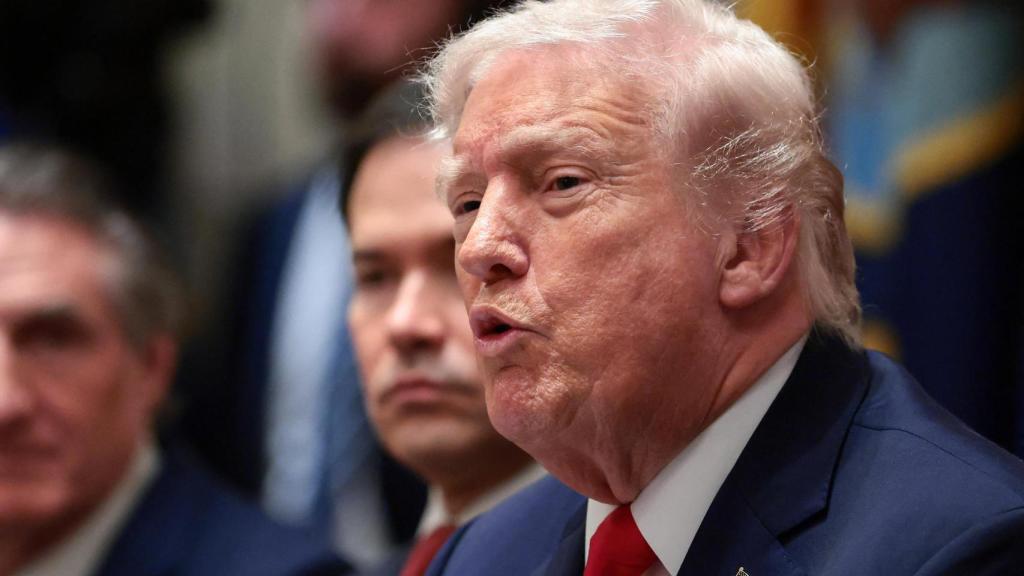
Donald Trump speaks during a cabinet meeting at the White House.
Reuters
According to ReutersIn addition, Trump set three conditions to rule out an attack and begin negotiations: prohibit the uranium enrichment process in Iran, limit the Islamic Republic’s ballistic missile program and that its armed wing stop supporting its allies in the region. In other words, dismantle the so-called Axis of Resistance, a network of militias that make up Hamas, Hezbollah or the Houthi rebels of Yemen.
In public, Iran is closed in. In private, the tone changes. The Islamic Republic wants to get rid “as soon as possible” of the sanctions that weigh down its economy. It urgently needs to improve the precarious material conditions of Iranians, which triggered the latest wave of protests.
Many question Tehran’s interest in reaching an agreement, but precedents fuel optimism. “Between 2013 and 2015, Iran negotiated with the West—even with the United States—to seal a nuclear pact that, according to all indications, it complied with until Trump decided to withdraw from it in 2018,” he recalls in conversation with this newspaper. Borzou Daragahinewsletter author Badlands.
“The real question is whether the Trump administration is willing to negotiate in good faith,” says the Iranian-American analyst. “It was they who blew up the nuclear deal, and who sabotaged the previous round of negotiations on the nuclear program, scheduled for June 2025, by authorizing and then participating in Israeli bombings against Iranian facilities and other targets.”
“Iran would be willing to make concessions, but in exchange for what?” Daragahi asks in this regard.
Repression
In Tehran they breathe a sigh of relief, but they do not let their guard down. The United States still maintains its military deployment in the Middle East, and can go on the offensive at any moment. No scenario is ruled out.
It is unlikely to do so, however, as long as Witkoff remains in the region. The New York real estate investor turned diplomat will hold a meeting in Jerusalem this Tuesday with the Israeli prime minister, Benjamin Netanyahuand another with the general Eyal Zamirchief of the IDF General Staff.
He will also be present at the negotiations that Russians and Ukrainians will hold this Thursday in Abu Dhabi, before heading to Istanbul.
Meanwhile, the Iranian regime celebrates the repression of the largest protests since the triumph of the Islamic revolution in 1979. No one shows remorse for the brutal campaign of repression, the bloodiest in the last 47 years. Nobody criticizes themselves for the poor state of the economy. The regime closes ranks.
Araghchi assured that the mobilizations “had nothing to do with the concerns or legitimate demands of the people” and accused the United States of orchestrating an internal “conspiracy.” Khamenei, for his part, defined the wave of protests as an exercise in “sedition” against the Islamic Republic.
“The recent sedition was similar to a coup d’état, although the coup was put down,” celebrated the supreme leader, who considered in his speech on Sunday that the objective of the protesters was none other than “to destroy the sensitive and influential centers in the administration of Iran.”
He also sang victory Hasan Khomeinigrandson of the Ayatollah Ruhollah Khomeinifather of the revolution. “The tragedy that could have brought Iran and the entire region into a crisis has come to an end,” the cleric celebrated, without mentioning the 2,985 people who, according to the official death toll, lost their lives in the protests.
Independent estimates are less conservative. HRANA, a prestigious Iranian NGO that works from exile in Washington, was able to confirm last week the death of 6,842 people at the hands of security forces. Another 11,280 deaths remain under investigation.
“For now, the protests are over, but that does not mean that the regime has overcome the challenge, in the same way that it did not overcome it in 2009,” warns Daragahi, who however acknowledges not being sure that the mass mobilizations that began at the end of December have posed the greatest threat to the clerics’ permanence in power.
“The 2009 uprising was much more dangerous, because then there was a faction of the elite that broke away from the regime and joined and supported the protesters. Among them were heavyweights like Mir-Hosein Musavi, Mehdi Karrubi y Hashemi Rafsanjani“recalls Daragahi. “This time that doesn’t happen, and there are no signs of division within the Revolutionary Guard either.”
“In Persian we have a saying that says something like ‘fire under the ashes’. And that is, basically, what Iran has been for a long time,” concludes the Iranian-American analyst. “There is a burning desire for change, a flame of rebellion against the regime. Power crushes that flame and believes it has put out the fire, but beneath it the embers remain lit, waiting for the moment to rekindle.”