
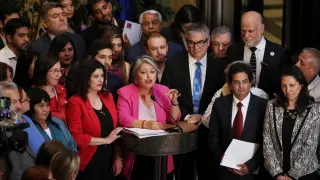

The leftist Jeannette Jara and the far-right José Antonio Kast will compete for Presidency of Chile in a second round the December 14 after a first round that has registered a record participation of 85%.
Unlike the first round of 2021, when 47.6% of the voters voted, this Sunday voting was obligatory low risk of fines of up to 97 euros.
Jeannette Jara, former Minister of Labor of the current Government of Gabriel Boric, has won with a 26.8% of the votesclosely followed by the far-right and leader of the Republican Party, José Antonio Kast, that he achieved 23,9%. Since none of them got 50% plus one of the votes, there will be a second round on December 14.
The communist candidate managed to win in key areas of Chile, from the center to the extreme south, including Coquimbo, Valparaíso, Aysén and Magallanes, in addition to the Metropolitan regionwhich houses the capital.
After winning, he stated that Chile is a country “with a lot of future and hope” and asked to take care of democracy so as not to put it “at risk” in the face of the second round.
Kast, for his part, led the vote in the southern regions of the country, including O’Higgins, Maule, Ñuble, Biobío, La Araucanía, Los Ríos and Los Lagos.
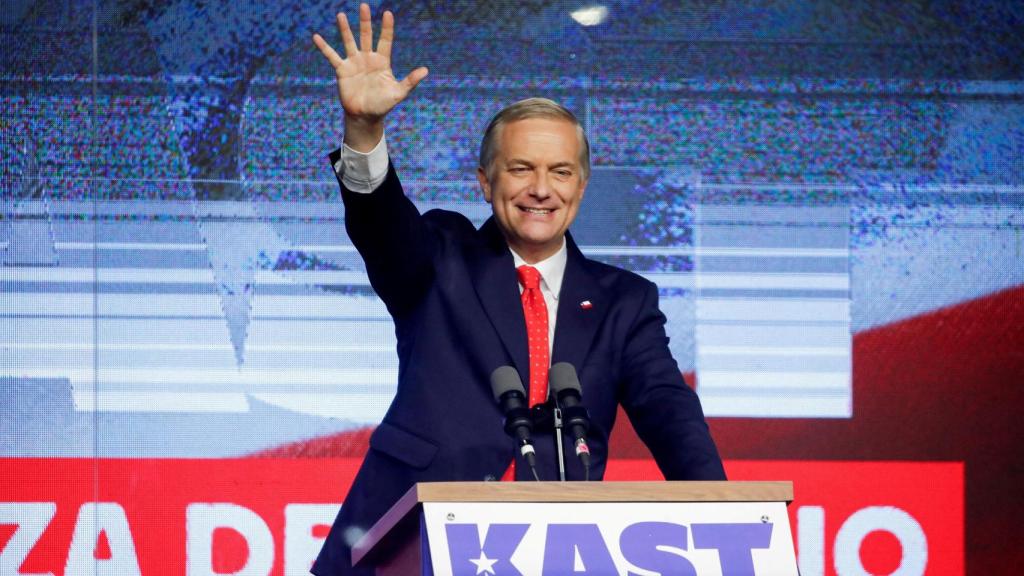
José Antonio Kast this Sunday after learning the election results.
Collapse of the traditional right
The big surprise of the night was the right-wing populist Franco Parisiwhich, as in the 2021 presidential elections, came in third place with 19.7% of the votes and considerable progress in the mining regions of the north of the country, such as Arica and Parinacota, Tarapacá, Antofagasta and Atacama.
Jara has already reached out to Parisi to reach an agreement for the second round. “I deeply value the VA’s proposal to refund the medications that are in its program,” said the leftist candidate for leader of the People’s Party, who after coming in third place has made it clear that will not give “a blank check” to neither of the two politicians who have gone to the second round.
The big losers of the day have been far-right libertarian Johannes Kaiserwhom many polls placed even above Kast, and the representative of the traditional right, Evelyn Matthei.
Matthei’s defeat confirms the retreat of the traditional right Chile, as happened four years ago, in favor of more extreme candidates. Despite this, he has already asked his voters to support Kast in the December 14 elections.
After knowing these results, the president Gabriel Boric He congratulated Jara and Kast in a public statement at the La Moneda palace in which he asked them for “a high-minded debate ahead of the runoff, always thinking about what is best for Chile.”
“Chile has a healthy democracy, a robust democracy that we cannot stop taking care of every day,” added Boric.
The elections are held in a context of great electoral fatigue after the successive elections held since the massive protests of 2019 and due to discontent with the management of Boric, whose approval is around 30% and who will leave La Moneda next March.
Since 2006, power has alternated between left and right and no president has handed over the presidential sash to a successor of the same political affiliation.
The more than 15.6 million people called to vote They also elect the entire Chamber of Deputies (155) and 23 of the 25 senators, an election whose counting will begin after the presidential recount and in which the polls predict a considerable advance of conservatism.
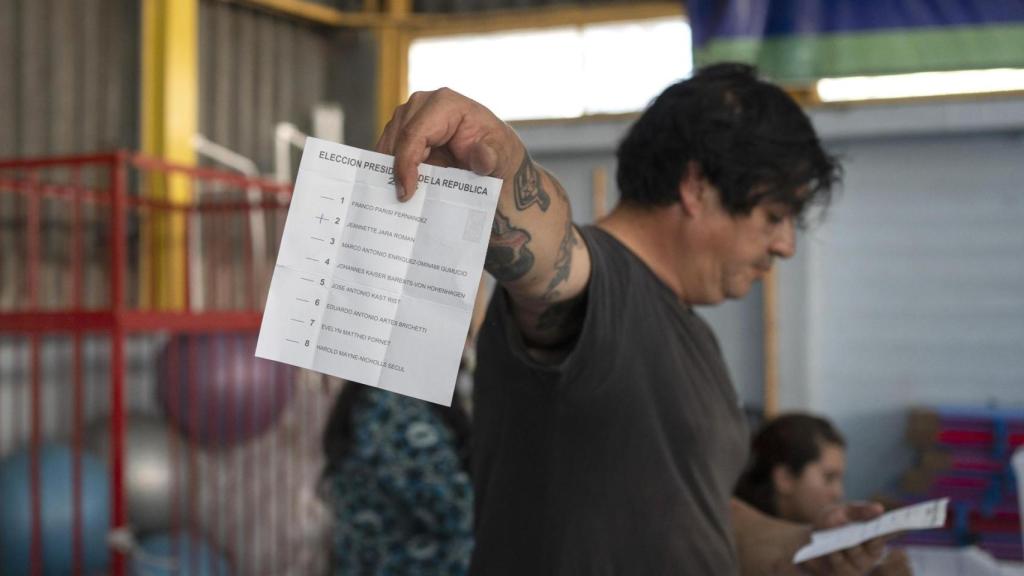
An electoral jury shows a vote in favor of the candidate for the Presidency of Chile for the Unidad por Chile party, Jeannette Jara, this Sunday in Valparaíso (Chile).
EFE
Mandatory vote
And all this in an election in which the Voting is mandatory.
The obligation was implemented in 2022 for the plebiscite on the first proposal for a new Constitution and after several elections with a very low participation, a product of the disaffection of citizens with the political class.
The unknown in these elections was who would benefit from compulsory voting and how that group of voters who usually did not go to the polls would decide, made up mainly of young people and depoliticized popular sectors without a defined ideology, according to experts.
To the uncertainty of mandatory voting, this Sunday was added that of migrant vote, since Chile is one of the countries with the greatest flexibility to allow foreigners to vote and migrants, mainly Venezuelans, have doubled since 2017