
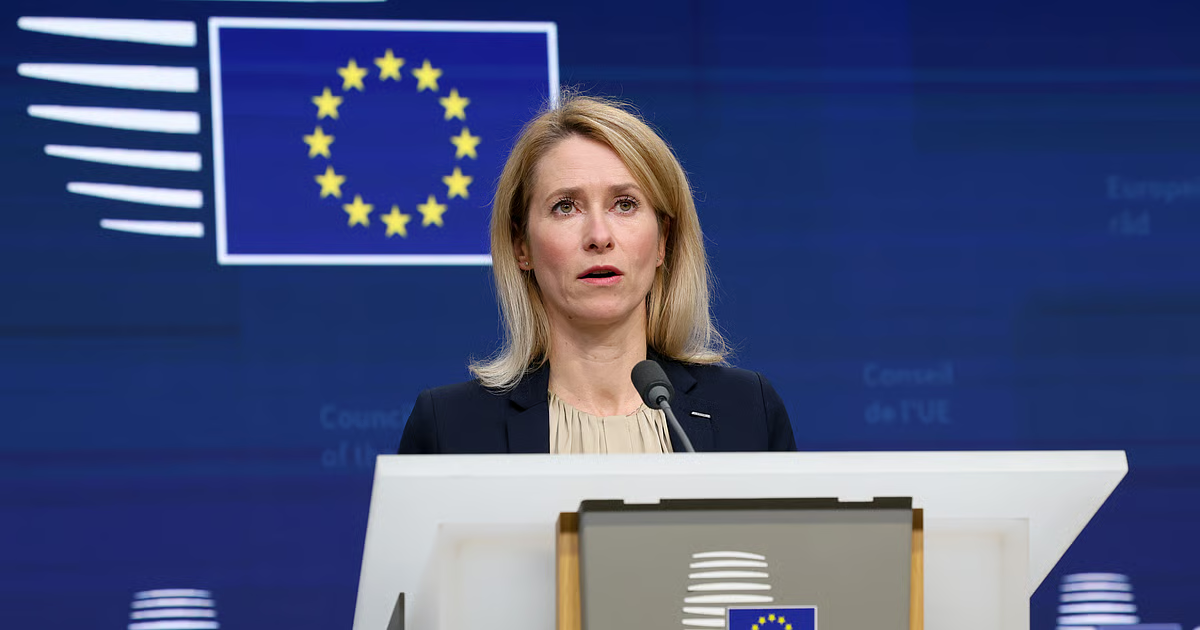

The European Union’s (EU) high representative for diplomacy considered that the week starting today “is decisive” in finding a solution for financing Ukraine, insisting that the best option is to use immobilized Russian resources.
“This week is decisive”, said Kaja Kallas, at the entrance to a ministerial meeting in Brussels.
The last meeting of EU Foreign Ministers, with the participation of Paulo Rangel representing the Portuguese Government, takes place days before the last European Council of 2025, where the 27 want to find a way to provide financial support to Ukraine for the next two years.
However, negotiations “are increasingly difficult”, acknowledged the former Prime Minister of Estonia.
Kaja Kallas considered that the use of Russian assets that are frozen in EU countries, one of the proposals on the table for discussion, continues to be the “most credible” way of solving the problem for 2026 and 2027.
Foreign ministers today discuss the proposal to support Ukraine for the next two years, to try to unblock it in time for the meeting of European Union (EU) leaders at the end of the week.
The Portuguese Minister of Foreign Affairs, Paulo Rangel, participates in the meeting in Brussels headed by Kaja Kallas.
Although there are other topics – namely the democratic path that Syria is taking a year after the fall of the Bashar al-Assad regime and the increasingly tenuous ceasefire between Israel and the radical Hamas movement, which administered the Palestinian enclave of the Gaza Strip – the meeting will focus on support for Ukraine for 2026 and 2027, and on the European Commission’s proposal to use Russian resources immobilized in the EU to pay for the destruction perpetrated by Moscow.
The Ukrainian Foreign Minister, Andrii Sybiha, will participate via videoconference and is expected to provide an update on negotiating efforts with the United States of America (USA), from which the EU was excluded by Washington, even though the agreement with Russia could outline Europe’s new security architecture.
Last Friday, the EU approved, by majority and with Hungary and Slovakia voting against, a decision to keep Russian assets immobilized indefinitely in the community space, serving as the basis for loaning reparations to Ukraine.
Bilateral meetings are currently taking place in Brussels to try to unlock European financing options for the country invaded by Russia in February 2022.
Two weeks ago, the European Commission proposed a controversial reparations loan based on frozen Russian assets and a smaller credit based on the EU budget, to support Ukraine in 2026 and 2027.
The first proposal faces opposition from Belgium, a country that hosts most of the frozen Russian assets (through Euroclear) and that demands clear guarantees and commitments from other Member States to protect itself legally, as it does not want to take the risk of running out of funds if Russia does not pay reparations.
The issue will be discussed by EU leaders at the summit in two weeks’ time, in a high-level meeting that is seen as decisive in reaching an agreement as Ukraine runs out of available funding next spring.