
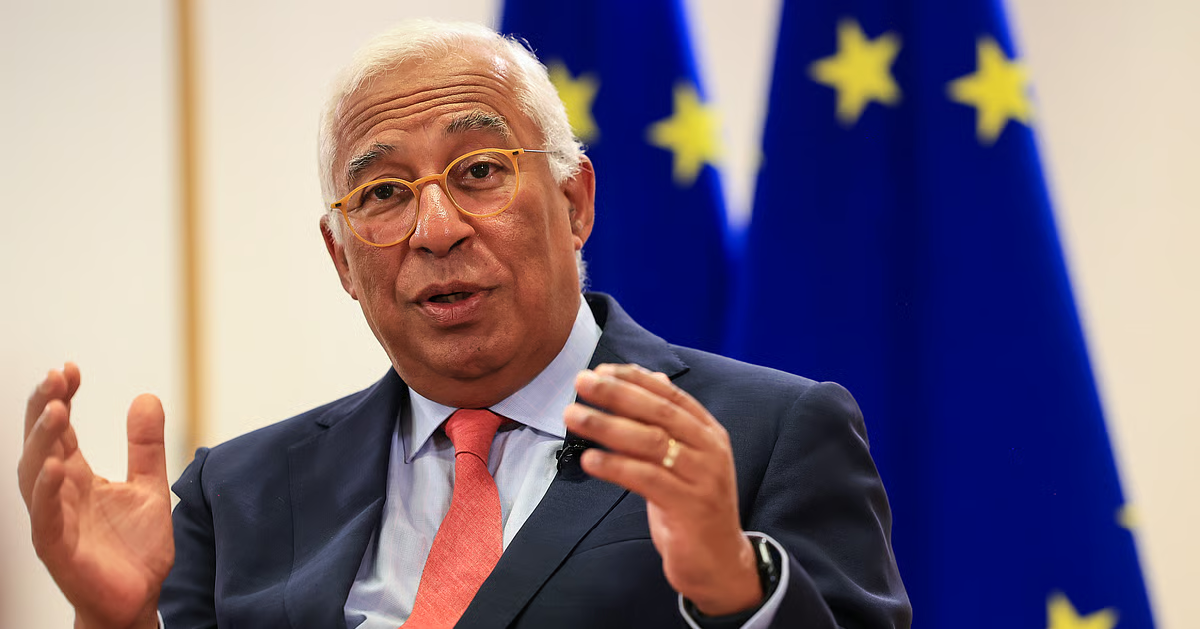

António Costa, president of the European Council, called this Tuesday, December 9, for “urgent action” from European Union (EU) leaders to financially support Ukraine in 2026 and 2027, when a reparations loan based on immobilized Russian assets is discussed.
In the invitation letter for the European summit scheduled for December 18th and 19th, sent this Tuesday to the EU heads of government and state, António Costa highlights that the meeting will be marked by “crucial discussions”, as “recent developments highlight the need for urgent EU action” with regard to aid to Ukraine.
“At the October European Council we committed to responding to Ukraine’s pressing financial needs for 2026-2027, including with regard to its military and defense efforts. At our next meeting we will have to decide, based on ongoing preparatory work, how to implement this commitment”, urges the former Portuguese prime minister.
“As always, I will try to keep our meeting for just one day, but my main priority is to implement the important decisions that must be taken, particularly regarding the financing of Ukraine”, warns António Costa.
The invitation letter is released as diplomatic efforts persist to achieve a fair and lasting peace in Ukraine, with the EU wanting to reinforce Kiev’s negotiating position, which means increasing pressure on Moscow.
Bilateral meetings are currently taking place in Brussels to try to unlock European financing options for the country invaded by Russia in February 2022.
Last Wednesday, the European Commission proposed a controversial reparations loan based on frozen Russian assets and a smaller credit based on the EU budget, to support Ukraine in 2026 and 2027.
The first proposal faces opposition from Belgium, a country that hosts most of the frozen Russian assets (through Euroclear) and that demands clear guarantees and commitments from other Member States to protect itself legally, as it does not want to take the risk of running out of funds if Russia does not pay reparations.
The reparations loan would imply that the community executive took out loans from community financial institutions that hold immobilized balances of assets from the Central Bank of Russia, thus being a credit based on Russian assets immobilized in the EU due to the European sanctions applied to Moscow for the invasion of Ukraine, which amount to 210 billion euros.
It would be reimbursed through ‘tranches’ and after payment of reparations from Russia to Ukraine and, given Belgium’s legal reserves, it would be accompanied by a solidarity mechanism in the Union.
The EU’s credit would be smaller, as it would involve taking advantage of the budgetary margin as a guarantee for Brussels to go to the markets and mobilize such an amount in favor of Ukraine.
The International Monetary Fund estimates that Ukraine’s needs for the next two years are around 137 billion euros, with the EU wanting to respond to them with two thirds, with a budget of 90 billion euros for 2026 and 2027.
The issue will be discussed by EU leaders at the summit in two weeks’ time, in a high-level meeting that is seen as decisive in reaching an agreement as Ukraine runs out of available funding next spring.
At this European summit, António Costa will also put the EU’s multiannual financial framework for 2028-2034 on the agenda, hoping to “take stock of the progress achieved so far and guide the next phase of negotiations”, with a view to “intense work to reach an agreement by the end of 2026”.
The President of Ukraine, Volodymyr Zelensky, will participate in the start of the summit, either in person or via videoconference.