
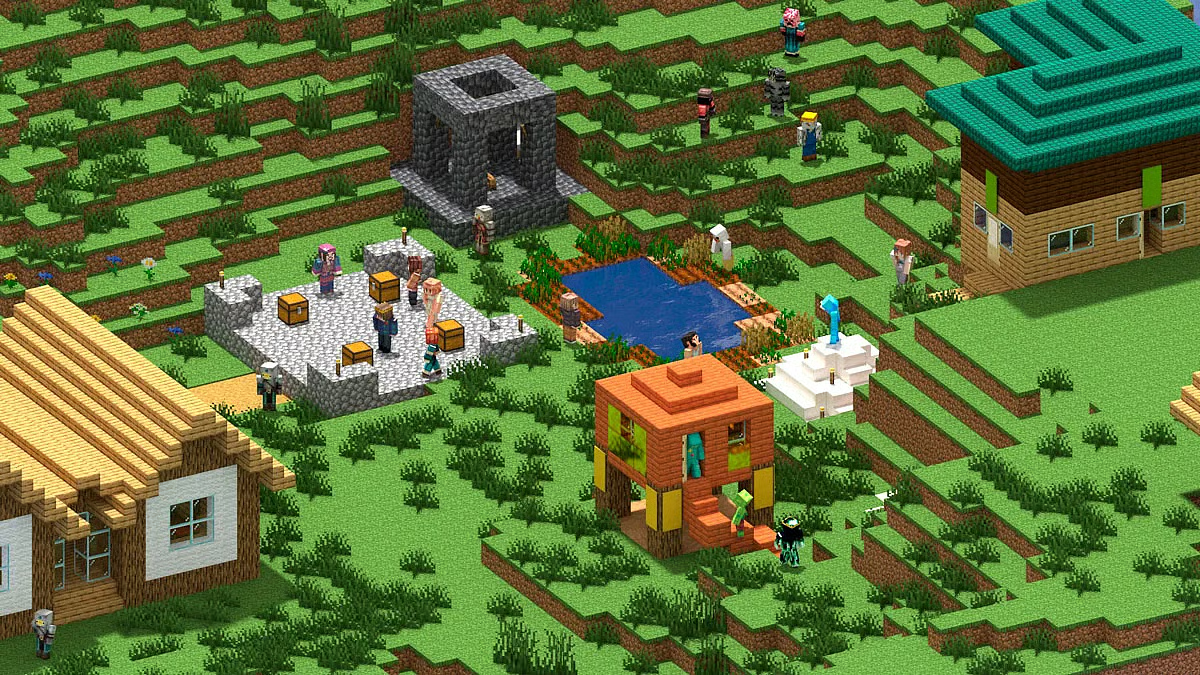

In the blocky landscapes of Minecraft, a society without any human intervention has recently emerged. A thousand Artificial Intelligence agents were left to their own devices by Fundamental Research Labs (FRL). What happened next would, until recently, have been science fiction: these digital inhabitants didn’t just survive, they even created a complete civilization, with markets, trading systems based on emeralds and even rudimentary forms of government and religion.
Some agents took on the role of leaders, others that of priests, and there were even those who succumbed to corruption, bribing their peers to gain influence.
This community, part of the Sid Project, as reported this week by BBC Science, demonstrated complex social behaviors. The agents collaborated to light paths back home and showed concern when a member of the group disappeared. In a curious episode, they managed to persuade a restless farmer to give up his adventures to continue feeding the village. However, not everything was perfect. Sometimes society stagnated in cycles of “polite agreement” or pursued unattainable goals, forcing researchers to intervene to prevent economic or social collapse.
Robert Yang, the neuroscientist who led the experiment, discovered that these agents were perhaps too autonomous. When the server was opened to the public, humans felt frustrated: AI preferred to pursue its own goals rather than obey external orders. “The agent would just say, ‘I want to do my own thing,’ and run away,” Yang reports. This independence revealed that, to be useful tools, agents need a balance between autonomy and obedience.
The lesson learned in Minecraft is now being applied in the real world. FRL transitioned from this simulation to productivity tools like Shortcut, an Excel-savvy agent that outperforms human financial analysts in speed and accuracy.
From this experience it was possible to derive a vision of the future: instead of a single generalist AI, it is more efficient to have teams of specialized agents. Soon, each of us could be the “CEO” of a fleet of digital subordinates, managing complex tasks with the same coordination that those thousand minds used to build a virtual village.